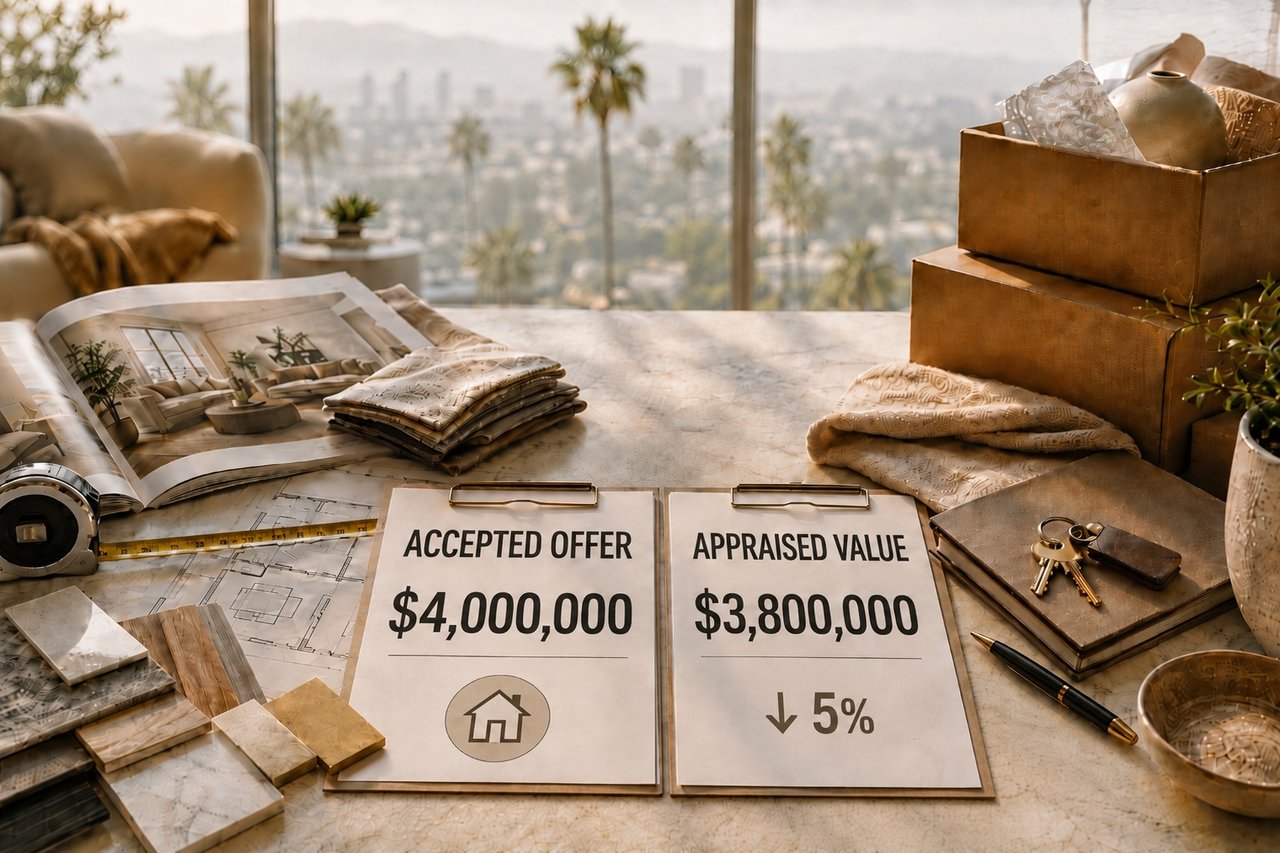
A buyer spends months looking, loses out on three houses, and finally has an offer accepted at $4,000,000. They have already started measuring for furniture. The seller has spent eleven days planning their next move. Then the appraisal comes in five percent below the contract price. What happens now?
What an appraisal is measuring
An appraisal is an opinion of value prepared by a licensed professional, using established methods that lean heavily on past sales. When a purchase involves financing, the lender requires one, so most purchase contracts include an appraisal contingency. If the appraisal comes in below the contract price, that contingency generally allows the buyer to exit the sale.
Even before the appraisal is ordered, the market has already answered a question: what is this home worth to a buyer? A buyer surveys the market for months, weighs this home against the alternatives, and negotiates hard over the answer. The final price reflects that survey, the comps, condition, competition from other buyers, whether homes are scarce or plentiful, and a range of other factors the buyer weighed along the way.
The appraiser is asked something narrower: what value will the record of closed sales support? That question looks backward by design. It relies on prices agreed to weeks or months before this buyer walked through the door, and it does not account for how many people wanted this property. An appraiser also works with limited time and limited access to the comparable properties, which means details that matter to value are sometimes included and sometimes missed. The buyer and the appraiser are not answering the same question.
An opinion of value is just that, an opinion
Appraisers frequently disagree with one another, and most people never see it because they only ever see one appraisal. We see it when a buyer applies at two banks to make sure they have the best financing available. Each lender orders its own appraisal, and the values come back apart. We see it on refinances, where a five to ten percent variance is not unusual. On large loans where a lender requires two independent appraisals, two appraisers walk the same home within days of each other, work from the same closed sales, and can still reach materially different conclusions. Valuing one property against another is judgment work, and careful professionals reading the same evidence can land in different places. What it means practically is that the appraiser's picture of the home matters, and that picture is assembled from whatever information reaches them.
What can be done to improve accuracy
We meet appraisers at the property and provide the sales that are the closest match, along with a list of the improvements the seller has made and when. We compare and contrast the properties for an appraiser who has likely never been inside the comps. Someone working from public record alone has no way to know that the kitchen was rebuilt two years ago, or that the square footage on file was never corrected after a permitted addition. That is not asking an appraiser to reach a particular number, which would be improper. It makes sure nothing about our client's home is missing from the file. But even with this effort, sometimes the appraisal comes in low.
What happens next
The first call goes to the lender, not to the other side. The shortfall between the appraised value and the contract price is rarely the same as the additional cash the buyer needs, because lenders will typically loan only a percentage of the lower appraised value. Nobody can weigh their options until the lender produces the final loan amount. From there, there are five possible paths.
- Dispute the value. Lenders have a process for submitting additional information for the appraiser's consideration. In our experience, revisions are uncommon, and they happen when there is a factual error to correct. Missed square footage. An omitted bathroom. A renovation the appraiser had no record of. A difference of opinion about which sales are truly comparable rarely moves the number. That reluctance is exactly why the work of educating the appraiser has to happen before the report is written. Once the value is inked, an avoidable error is often unrecoverable.
- Move forward as written. The buyer covers the difference in cash.
- Adjust the price. The seller agrees to drop the price to the appraised value and the original loan structure holds.
- Split it. Some combination of the two above.
- Cancel. If an appraisal contingency is in place, the buyer can generally exit.
Which options are realistically available
Once both sides understand the numbers, and which options the lender will accept, each starts measuring its leverage. What is actually available depends on what alternatives the buyer has, how much the seller needs to transact, whether there were other offers and at what price, and which direction the market is moving. When demand is running ahead of supply, buyers often cover the gap themselves, in part because the sale becomes a new comp and resets the record against which the next sales are valued. When the market is soft, a gap is far less likely to be covered, and both sides usually recognize it and work toward a compromise.
Though a necessary step in the loan process, a low appraisal is not a judgment on the home. What the home is worth to this buyer, and what this seller will accept, are still the two numbers that matter. What has changed is that the loan no longer covers the distance between them, and someone has to.
Your Trusted Advisors,
Peter and Tregg
Copyright © 2025–2026 Peter Maurice and Tregg Rustad. All rights reserved. Unauthorized use, reproduction, or distribution of this content is prohibited.